

Hospitals operate 24/7 and depend on organized shift schedules to provide constant patient care.
Nurses and administrators benefit when shift lengths and scheduling models are clear, since staffing decisions affect workload, employee health, and overall service quality.
Common patterns include 8-hour, 10-hour, and 12-hour shifts, along with fixed or rotating assignments.
Let’s check all of these out.
Nurse Shift Lengths in Hospitals

Nursing schedules vary across hospital departments, but most full-time roles follow consistent weekly hour expectations.
Staffing models depend on patient volume, acuity, and institutional needs, so shift length plays an important role in ensuring stable coverage and manageable workloads.
Nurses also depend on comfortable, functional workwear, including quality hospital scrubs designed for long shifts and demanding clinical environments.
Full-time nurses generally work about 36 to 40 hours per week, though totals may differ depending on the unit, specialty, or scheduling approach.
Common hospital staffing relies on several standard shift formats.
Key options include the following:
- 8-hour shifts, often associated with outpatient clinics and select hospital areas
- 10-hour shifts, supporting four-day workweeks while maintaining continuity of care
- 12-hour shifts, widely used in inpatient units where three shifts often meet weekly requirements
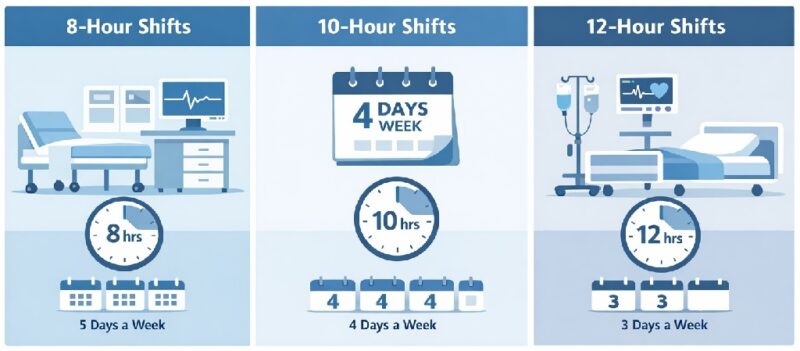
8-Hour Shifts
8-hour shifts remain one of the most traditional schedules in nursing.
Many outpatient settings and specialized departments continue using this format because it allows predictable daily staffing and shorter work periods.
Nurses working 8-hour patterns may have more consistent routines across the week, though more workdays are usually required to meet full-time hours.
10-Hour Shifts
10-hour shifts provide an intermediate schedule choice. Four shifts per week often fulfill full-time expectations, giving nurses an extra day off compared with 8-hour structures.
Coverage remains reliable while offering more recovery time between workweeks.
Hospitals may use this model in departments seeking a balance between staffing demands and employee time away from work.
12-Hour Shifts
12-hour shifts have become the most common arrangement in inpatient hospital care.
Nurses frequently complete three shifts per week to reach full-time status.
Longer hours reduce the number of shift changes, which can support continuity for patients.
Demands may increase across extended workdays, so rest and fatigue management become essential.
Less Common Variations
Some specialized roles require scheduling outside standard formats.
Emergency services and critical care may involve extended or split shifts when staffing pressures require flexibility.
Such patterns appear less frequently but remain part of certain high-demand hospital environments.
Day Shift Explained

Day shifts represent the busiest hospital period, when most clinical coordination occurs.
Staffing during daylight hours must support high patient activity, frequent procedures, and intensive communication between healthcare teams.
Day shifts usually begin early in the morning, often around 7 a.m., continuing through mid-afternoon or early evening.
Peak workload occurs during these hours, shaped by rounds, diagnostics, admissions, and interdisciplinary planning. Common responsibilities include:
- physician rounds and treatment updates
- scheduled procedures and testing
- discharge planning and patient education
Benefits of Day Work
Day schedules align closely with normal sleep rhythms.
Nurses working daytime hours often find personal scheduling easier, especially for family routines, appointments, and social obligations.
Predictable daytime staffing also provides broader access to support services, administrators, and specialty teams.
Challenges of Day Work
Daytime nursing can be highly demanding due to increased patient movement and constant clinical activity.
High volumes of communication, coordination, and interventions often make day shifts the most intense portion of hospital operations.
Night Shift Explained
Night shifts ensure uninterrupted patient care during hours with reduced hospital staffing.
Overnight nursing requires independence, strong clinical judgment, and adaptability when fewer support resources are available.
Night shifts commonly run through evening and early morning hours, such as 7 p.m. to 7 a.m. under a 12-hour schedule.
Fewer administrative and ancillary services operate overnight, so nurses frequently manage broader responsibilities with greater autonomy.
Pay and Work Environment
Many hospitals offer financial incentives for overnight staffing.
Shift differential pay is one of the most common features of night work.
Quieter surroundings may also support focused clinical monitoring, especially for stable patients needing ongoing observation.
Physical and Social Challenges
Night schedules disrupt natural sleep cycles, often leading to fatigue and reduced alertness. Social and family routines can become harder to maintain.
Sustained overnight work has also been linked to potential long-term health risks tied to circadian disruption and sleep imbalance.
Rotating Shifts in Healthcare
Rotating schedules play a major role in hospital staffing because patient needs continue without interruption across every hour of the day.
Many healthcare facilities depend on rotation to ensure that nurses are assigned across daytime, evening, overnight, and weekend hours in a balanced way.
Stable staffing requires systems that prevent certain groups of workers from carrying the full burden of less preferred schedules.
Rotating shifts involve preset schedules that cycle nurses through multiple time blocks across a defined period.
Movement may occur weekly, biweekly, or over longer rotations depending on hospital policy.
Rotation helps distribute nights, weekends, and holiday assignments more evenly instead of leaving those hours permanently assigned to only a few staff members.
Common Rotation Patterns
Hospitals rely on structured cycles that repeat across weeks or months.
Rotation patterns differ depending on department needs, staffing size, and patient care demands.
Common approaches include sequential movement through shifts or longer block assignments. Common models include the following:
- day to evening to night progression across a set cycle
- multi-week blocks, such as two weeks of day duty followed by two weeks of night duty
- weekend rotation requirements spread across the month
Some hospitals schedule rotations gradually to reduce abrupt transitions, while others rotate more quickly to prevent staff from remaining on nights for extended periods.
Advantages of Rotating Work
Rotation strengthens shared responsibility within nursing teams.
Nurses gain experience across multiple shift environments, which supports adaptability and broader clinical awareness.
Exposure across different schedules can improve teamwork and help units remain flexible when staffing changes occur.
Benefits often include:
- fairer distribution of nights and weekend hours
- stronger cross-shift communication skills
- wider experience with varying patient activity levels
Rotating nurses also become familiar with both daytime coordination and nighttime independence, supporting more complete professional development across hospital care settings.
Challenges of Rotation

Sleep disruption remains one of the greatest difficulties tied to rotating schedules.
Transitioning between day and night work interferes with circadian rhythm and can reduce consistent recovery time.
Adjusting to frequent schedule changes may create ongoing fatigue, especially when rotations occur rapidly.
Major concerns associated with rotation include:
- difficulty maintaining stable sleep patterns
- strain on family and social routines
- reduced alertness during transition periods
Effective scheduling support becomes essential during shift changes, since inadequate rest between rotations increases exhaustion risk.
Closing Thoughts
Hospitals depend on multiple shift lengths and scheduling models to provide uninterrupted care.
Day shifts focus on the busiest clinical hours with extensive coordination and procedures.
Night shifts concentrate on essential monitoring and care during quieter periods, often with added pay incentives.
Rotating schedules support fairness and coverage across teams.
Selecting an appropriate schedule requires balancing institutional staffing needs with health, lifestyle, and long-term sustainability for nursing staff.